

Key principles to planting, managing backyard slopes
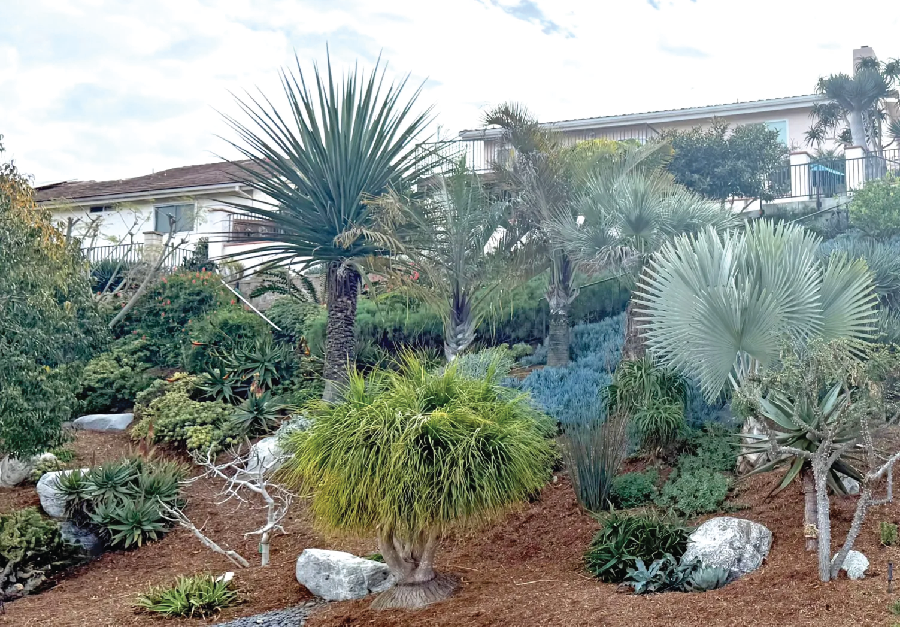
Boulders and mulch on a slope add beauty, soil retention and safety. (Jodi Bay)
A look at soil, plant choices, erosion and fire risk
By Michael Harrelson
(This article was originally published in the March 14, 2026 edition of the San Diego Union-Tribune)
From its 70 miles of coastline to the 43 square miles of open desert in Borrego Springs, San Diego County’s topography is widely varied, marked largely by a hilly geography. The highest section in our area is the Laguna Mountain range to the east, with most of the county cascading west toward the sea.
Tectonic movement has shaped San Diego County into a rough collection of valleys, foothills, urban canyons and mesas. Within the city of San Diego alone, there are approximately 200 canyons, and at the top of each of these are mesas where we build our homes. Looking out over a slope is a familiar scene for many. Deep canyons are best left to the raccoons and coyotes that call them home.
A sloping backyard, on the other hand, is something that needs to be addressed by the property owner to mitigate the risk of fire danger and to avoid erosive damage
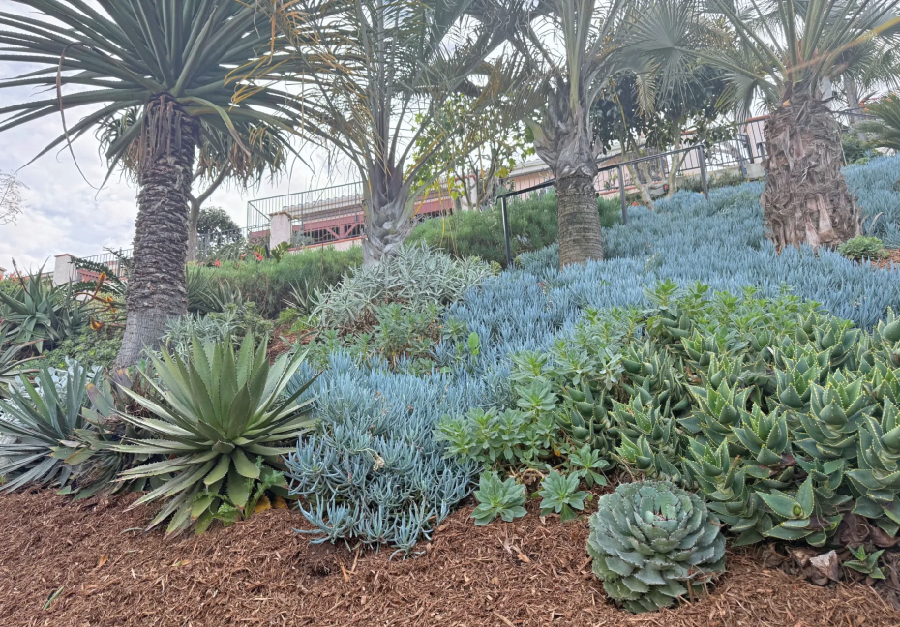
Succulents on an embankment are waterwise and attractive. (Jodi Bay)
Slopes or embankments are classified by their gradient (vertical rise over 100 feet). Generally, steep slopes are identified as having a 25% or greater gradient. A moderate slope will be 10% to 25%, whereas gentle slopes rise 5% to 10%.
Regardless of degree of slope, the landscape needs for each will employ the same four principles: erosion control and soil stabilization, plant selection, water management and mulching. A fifth consideration must be safe access to what has been created.
Soil
First and foremost, when landscaping any slope, ensure that the soil at the top does not end up at the bottom — and beyond. As an initial step, laying down some type of biodegradable fabric, such as jute netting, should be done. Plastic weed block sheets are not recommended because they will not absorb water from a sustained downpour quickly enough to impede runoff, and they are highly flammable. Jute netting and other such landscape fabrics are natural and have the appearance of widely woven burlap.
Once the landscape fabric of choice has been set upon the embankment, hold it in place with turf staples (nongalvanized will deteriorate faster but last long enough for the landscape fabric to become part of the soil).
For steep slopes, wattles can be placed in strategic locations to slow down runoff and catch soil that may wash down. Some steep slopes need a little more engineering in the way of terracing, retaining walls or placement of boulders at different water inflection points on the embankment. These can be big projects and may require the assistance of a knowledgeable landscape designer.
Plants
Plant selection is an important element. The right plants will assist with soil stabilization and water management. The rule of thumb is to plant smaller plants with low water needs at the top of the embankment. Larger plants with a greater irrigation requirement should be placed middle to bottom of the slope where they will benefit from water flow assisted by gravity.
Top to bottom, consider using native plants which, hereditarily, are adapted to our climates and will more easily root. Getting plants set quickly will facilitate soil stabilization. Fifty percent of vegetation placed on an embankment should be deep-rooted, such as trees and larger plants whose leaves retain moisture — think succulents. For fire safety, avoid woody spreading plants like prostrate acacia (Acacia redolens) and plumbago (Plumbago auriculata).
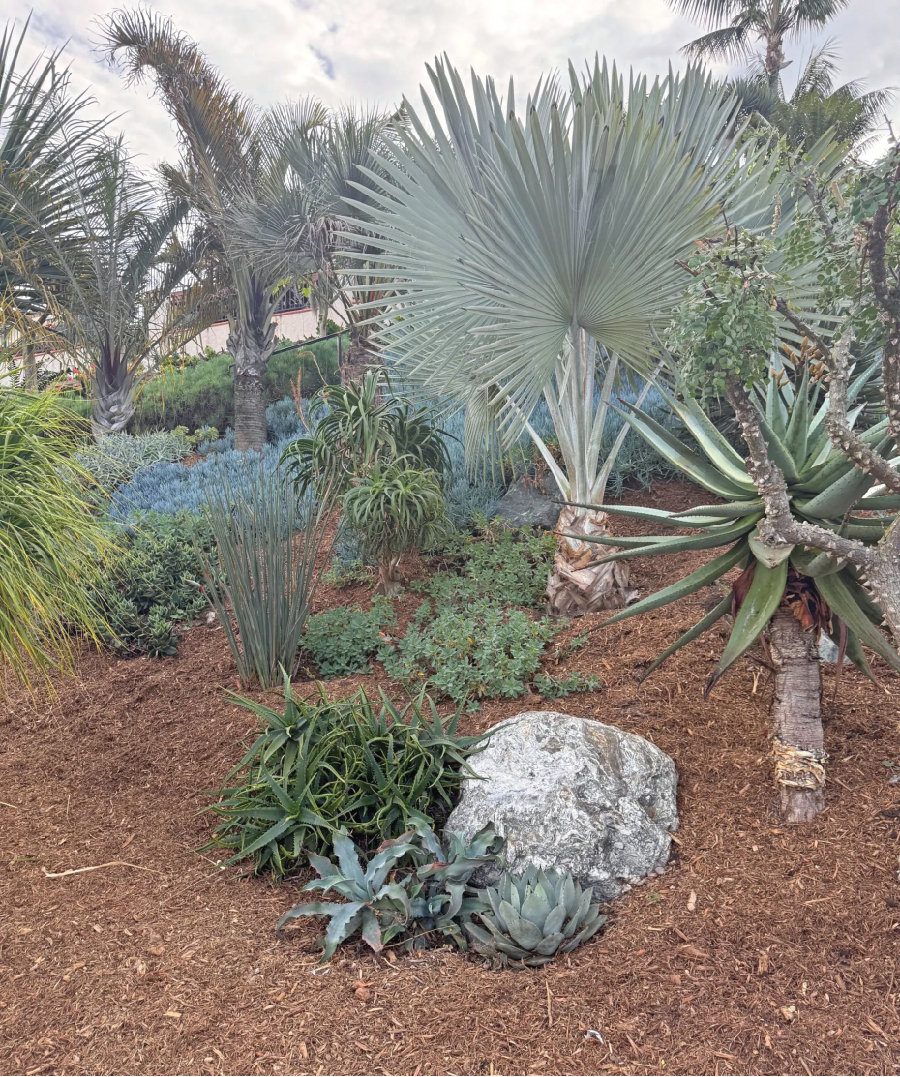
A cityscape embankment with succulents and well-spaced trees. (Jodi Bay)
The spacing of trees on a slope is important. CalFire recommendations for horizontal clearance between trees is based on the degree of slope: 20 feet between trees on a moderate slope, 30 feet for steeper slopes. Always trim tree branches six feet from the ground. Fire moves uphill, so protect your property.
Water
The key to water management is simple, drip irrigation. On moderate and steep slopes, sprinklers and bubblers are not efficient means of providing water to the plants, nor will they effectively keep water on the slope, where it is needed. Drip systems deliver water right to the location where it is required with high efficiency and minimal waste.
As with all irrigation, regularly walking the system will help identify small problems before they become big problems. Breaks in micro tubing will deny the targeted plant the moisture it needs, and a broken main line has the potential to wash out a large area and do collateral damage to neighboring properties.
Mulch
In any landscaped area, mulching is a critical element. On embankments, consider using pieces of large wood chips interspersed with rock, gravel, paving stones or any other inorganic material.
Covering a slope with organic compost has the potential of transmitting fire across a wide area. Building fireproof “zones” within the sloped landscape will diminish that possibility. Zones of organic and inorganic mulch also create an opportunity to build in safe, flattened pathways that allow access for irrigation line monitoring and plant maintenance.
Living in San Diego County means living with sloped backyards. They don’t have to be raw dirt or catch-alls for windborne weed seeds. With a little bit of thought, homeowners can create a dramatic space where beauty, water conservation and fire safety blend together harmoniously.
Harrelson has been a San Diego Master Gardener since 2012. He practices low-water landscaping at his home in Jamul.