

A Life Changing Experience From a Plant? Yes, and then I discovered more in the Proteaceae family…

These beautiful Proteaceae flowers are Banksia spinulosa, Leucadendron ‘Safari Sunset’, Banksia speciosa and Protea ‘Pink Ice’. Your friends will be in awe, when bring them a bouquet such as this, with cut-flowers from your garden. (Mo Price)
By Mo Price
Have you ever seen a plant so unique and beautiful that it had an impact on your life? It happened to me 22 years ago, shortly after becoming a volunteer at San Diego Botanic Garden in Encinitas. The plant was a Hairpin Banksia (Banksia spinulosa); it had a bright yellow-orange 7” x 3” cylindrical inflorescence with bristling stamens.
I consulted my gardening books, (the internet was almost non-existent at that time) researched the plant and discovered that it is native to Australia and in the Proteaceae Family. At the Garden, a week later, I saw another incredible plant, a Pincushion (Leucospermum spp). I researched and learned that this native from South Africa was also in the Proteaceae Family.
Hmmm, this was curious. I visited local nurseries, looking for plants in the Proteaceae family. To my dismay, there were none to be found. This iconic family dates back 80–160 million years when the Southern Hemisphere supercontinent Gondwana separated. The Proteaceae family was widely distributed and evolved to produce diverse genera. The Mediterranean climate of South Africa became home to the Protea, Pincushion (Leucospermum spp), Coneflower (Leucadendron spp) and Mimetes, while Australia became home to Grevillea, Banksii, Macadamia, Stenocarpus, and Telopea, to name a few.
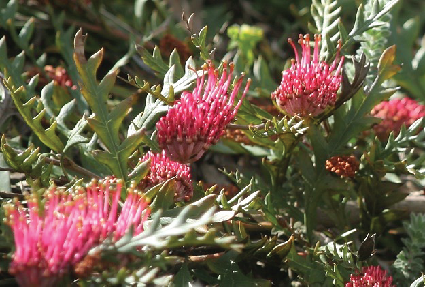
Grevillea x ‘Gaudichaudii’ is an evergreen groundcover, reaching 1’ in height with a spread of 15’. Occasional pruning back will thicken growth sufficiently to become impenetrable to most weeds. (Mo Price)
Since I could not find any Proteaceae plants, I ordered seeds from South Africa and researched their requirements:
Natural Habitat
The successful cultivation of plants of the Proteaceae family is to a large extent dependent on a fundamental understanding of their natural habitats. Their requirements are specific, yet their needs are basic. They grow in well-draining soils with notable mineral deficiencies. Most grow in Mediterranean climates – cool and moist over winter with arid summers.
Nutrients
It is believed that Proteaceae evolved in poor soils so that they could survive in comparatively hostile environments where the likelihood of invasion by competitive species would be minimal. Since they grow (naturally) in soils with mineral deficiencies, Proteaceae roots are lateral and often conspicuously close to the surface of the ground, seeking nutrients and moisture. Fertilizers, especially those containing phosphorus can harm the plants.
Planting
Sunny, open, airy situations are best for most species. Sunny positions usually enable the flowers or bracts to develop their optimum color; shaded positions make for softer colors and weaker, spindly plants. Air circulation helps to keep foliage free from fungal problems and pests, so do not crowd. If possible; plant on a slope to allow for water runoff. Flat situations where damp soils prevail are not suitable. Proteaceae roots are sensitive; do not damage while transplanting. Once planted, do not dig or cultivate around the plants; remember that their root system is near the surface and does not like to be disturbed.
Water
Instead of using overhead watering during bright sunlight hours, it’s best to water with drip irrigation once a week in the morning.
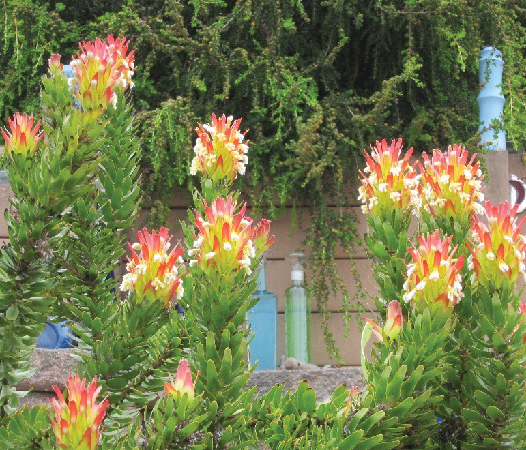
Mimetes cucullatus is an evergreen shrub with upright stems 3’ – 6’ high. The bright red terminal leaf bracts encase white-tufted flowers. (Mo Price)
The Protea seeds were easy to grow, and I transplanted 10 seedlings into the ground. Some of these, such as Protea ‘Pink Ice’ and Protea ‘White Repens’ still bloom profusely every winter thru spring. When I deadhead the spent flowers, I drop them on the soil for mulch. I now have countless volunteers in my garden, some of which now flower.
Eventually, many plants in the Australian Proteaceae family became available in nurseries. I was easily hooked, purchasing every plant I found. The Grevillea and Banksia seem to be the most reliable. I learned that these plants have similar requirements as my California Natives and other Mediterranean plants, so I mingle them in my garden with never a worry.
You can grow them too; it is probably easier than you think!
Mo Price is a UC Master Gardener and a Docent at San Diego Botanic Garden where she enjoys teaching classes about Mediterranean Climates. Leading tours is a favorite activity at the Botanic Garden.