

What is Hydrozoning and How Does it Work?
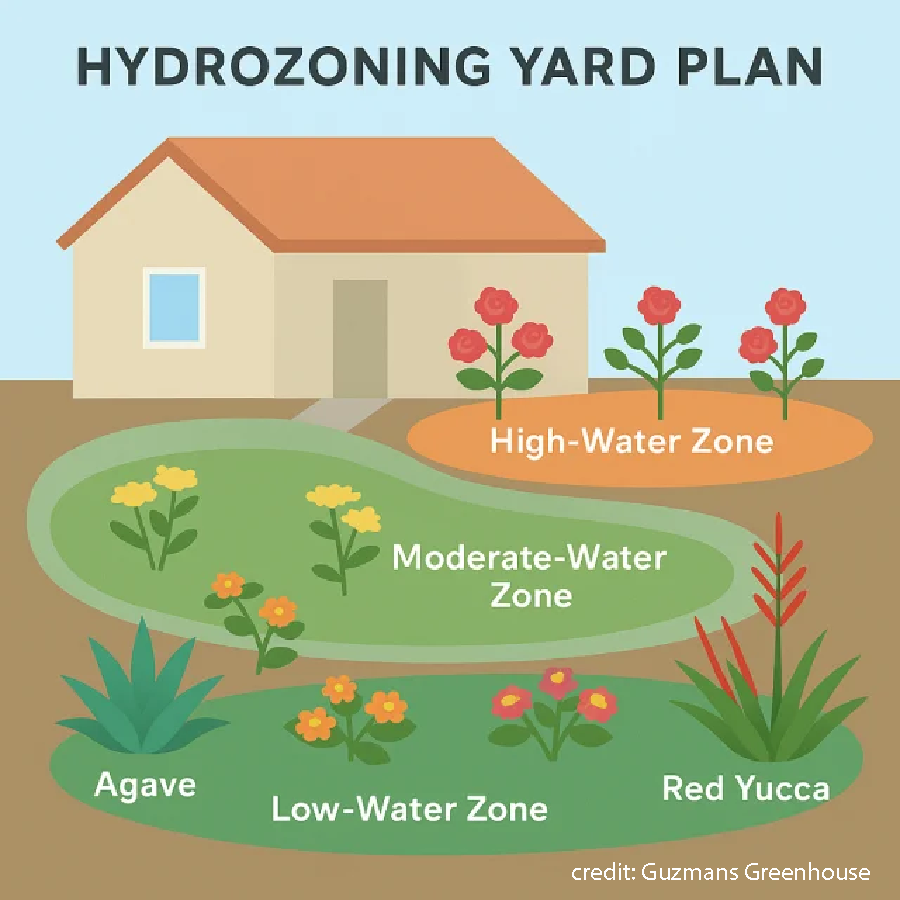
Hydrozoning yard plan image credit: Guzmans Greenhouse
Question: I’ve heard the word “hydrozoning” – what is it and how does it work?
Answer: Hydrozoning is key for a healthy garden. Here’s why:
Last month in “Dig It!” we provided a guide for assessing the effectiveness of home landscape irrigation in relation to optimizing plant health and reducing disease and disorders. Many problems in our landscapes and home gardens begin with improper watering that causes stress to the plants. Once stressed, plants become more susceptible to pests, soil disorders, and environmental (weather) changes. This article will provide more information on “Hydrozoning”, grouping plants with similar watering requirements, as hydrozoning and irrigation zoning go hand in hand.
Why implement hydrozoning?
Ideally, designing and planning our landscapes and gardens would begin with the thoughtful grouping of plants that have similar irrigation needs. You might categorize plants’ watering needs on a scale of 1-5; there are no plants that need zero water. With automated systems, this method of hydrozoning allows watering plants with the same needs on the same valve and controller station on programmed schedules. If the landscape is a new garden project, there are steps you can take to make your efforts more efficient and effective as plants mature. Gradually adding compatible plants to each hydrozone is also a good approach in an existing garden. Master Gardeners use the phrase, Right Plant, Right Place, to convey the concept of putting the right plant in the right place as the first consideration of landscape and garden planning.
Hydrozone planning is based upon 1) estimating the drainage and depth of water penetration in the soils and 2) the root-absorbing activity of each plant and then all the plants within each hydrozone. The root-absorbing activity is based on three general categories of plant types and root depths:
- leafy vegetables and annual bedding plants: top 6 inches to 1 foot,
- cool-season turfgrass and flowering perennials: top 6 inches to 1-1/2 feet,
- shrubs, trees, ground covers, vines, warm season turfgrass, and most non-leafy vegetable crops: top 1 foot to 6 feet. Succulents: Succulents are a large and diverse group of drought-tolerant plants that store water in their stems, leaves or roots. Root systems of most succulents are shallow, but some grow down to 12 inches. This allows them to survive in conditions that are too dry for many plants. Cacti comprise one group of succulents because they store water in their stems. Cacti with fine hair-like root systems are generally shallow rooted, 1 inch to 12 inches. There are many cacti that establish tap roots (a stout, tapering main root from which many lateral roots extend). Taproots of some cacti, such as the Saguaro, can extend as deep as 12 feet.
- Native plants: Native plants are deeply rooted and have adapted over millions of years to hold moisture in below ground systems to survive in regions with low rainfall, drought, and in some areas very low humidity. There are categories of native plant communities - plants that form a special relationship with each other, within their own setting such as coastal, desert, riparian, marshland, etc. These plant communities have adapted to climate and microclimates, soil type, sun exposure, and water availability. San Diego County has a diverse range of native plant communities. The best way to understand which native plants are suited for your landscape is to use the Find Plants tool on the CalScape website (https://calscape.org) by simply creating a login and entering your zip code.
Because actual root depths depend on many factors, it is advised to test or sample soil around each plant or in several spots within a hydrozone along with the category guidelines provided. Our May 2026 Dig It! FAQ article discussed several methods to test soil moisture. The easiest is a soil moisture meter probe device.
Next month, we’ll cover irrigation systems and hydrozoning.
Sources:
Earth Friendly Gardening (EFG) – a resource rich questionnaire to aid garden planning while practicing sustainability and more! https://ucanr.edu/site/uc-master-gardener-program-san-diego-county/earth-friendly-gardening-0
Suggested resources to help you learn more about plants that can thrive with less water in San Diego County:
- Metropolitan Water District: https://www.bewaterwise.com/garden.html
- California Native Plant Society, San Diego Chapter: https://cnpssd.org/
- The San Diego Natural History Museum Nature Walk has native plants with indigenous uses: https://www.sdnhm.org/exhibitions/nature-trail-at-the-nat//
- Native and waterwise plants are on display at the Water Conservation Garden on the campus of Cuyamaca Community College: https://thegarden.org/
- In North County, visit the native plant area at the San Diego Botanic Garden: https://sdbg.org/
Valorie Shatynski has been a Master Gardener since 2016