
El Niño is not a storm
But El Niño does change the circulation across the world, which can cause weather events to recur and become more likely over the course of months/seasons

- If an event occurs that is consistent with El Niño, we can say this event might have been made more likely by El Niño, but El Niño cannot be solely and entirely blamed for individual events.
- Synoptic features + Other climate patterns/trends can also play significant roles in modulating the likelihood of weather or extremes.
- Stronger El Niños can make these circulation "highways" more dominant (signal>noise) and can often more strongly push the distribution of possible outcomes.
What to expect? What can you do? Don’t panic! Prepare early.
The El Nino forecast provides an opportunity to prepare early. Reliable short-term weather forecasts are the best sources for when an actual storm or wind event will occur. (Some references are provided at the end of this article.) Local agencies have already begun to offer sand bags to help protect structures, including the home, Clear gutters and drains now. The following provides suggestions for landscape preparations.
Examine the setting
Drainage diversion, erosion control and tree trimming are some primary goals when preparing for storms. Take time to examine the landscape closely and consider past impacts of heavy rainfall and winds. Did past rainy periods result in areas where water would back up or pond? Where did water rush off hard surfaces rather than absorbing into the soil? Do gutters and down drains feed into garden beds or onto driveways and sidewalks, creating standing water or washouts? Are there slopes where erosion and runoff show cracks, rills, erosion? Do trees and shrubs that have not been pruned recently have limbs that could snap in windy conditions? Could these downed branches damage structures or fall in places that could be dangerous like on parked cars or sidewalks?
Ways to prepare landscapes, gardens and slopes:
Deep-rooted plants, especially native plants are one of the ideal landscape and slope protection measures. An important strategy for yard and canyon slopes is to plant deeply-rooted plants which send their network of root systems down and out from the base of the plant. This network of root systems holds soil in place and absorbs water to mitigate slope erosion and movement. Because stability of the slope is a consideration, native plants are specially adapted to our regional soils. Research has shown that slopes appropriately planted with natives provides a low tech, long term, more affordable and vastly more attractive solution than jute blankets or concrete covered slopes. Another benefit of native plants is fire resistance.
A note of caution regarding ice plant on slopes. In the past, ice plant was commonly believed to be the best solution on slopes. Over time, with research and experience, ice plant is no longer recommended for slopes. Ice plants are very shallow rooted and when hydrated with irrigation or rain, the plant actually becomes very top heavy. This combination actually increases the risk of erosion and slope failure (see Reference section for more).
Most deeply-rooted native plants are evergreen , and many have beautiful flowers, some during the winter/spring, others spring/summer, and yet others that flower summer or nearly year-round. Native plants from this region range from short ground covers (such as the buckwheat family or dwarf coyote bush), to medium shrub size (Ceanothus “wild lilacs”, saliva/sage family), to small tree sizes such as Toyon, Lemonade berry, and more. Additional benefits with native plants are that after the first year, very little water is needed, except occasionally during dry months. Birds and the insects which birds eat thrive with native plants. Mixing native plants with other low water plants is a great way to keep favorites and avoid a complete landscape make-over.
See the reference section below for resources to identify the best native plants and other ornamental plants for specific applications and where to obtain them. The ideal time to plant is November through March, when the weather cools a bit. Sooner is better to allow the root systems time to establish and take advantage of the winter rains.
Modify the landscape from flat to formed, sloped to terraced. Many yards and landscapes are built flat to accommodate expanses of lawns, the left with slopes surrounding the flat areas. Both the flat and sloped areas tend to increase runoff and erosion, and are much less interesting to the eye when compared to a landscape with some mounding, low points, and terracing. “Terra-forming” in yards can include high points (slight mounds) which drain into lower areas with swales or creek beds, combined with some terracing and plants which are more attractive, and capture rainwater and runoff so it can percolate onsite. When water and stormwater is captured to percolate into the soil, it is very beneficial to our deeply rooted trees and shrubs.
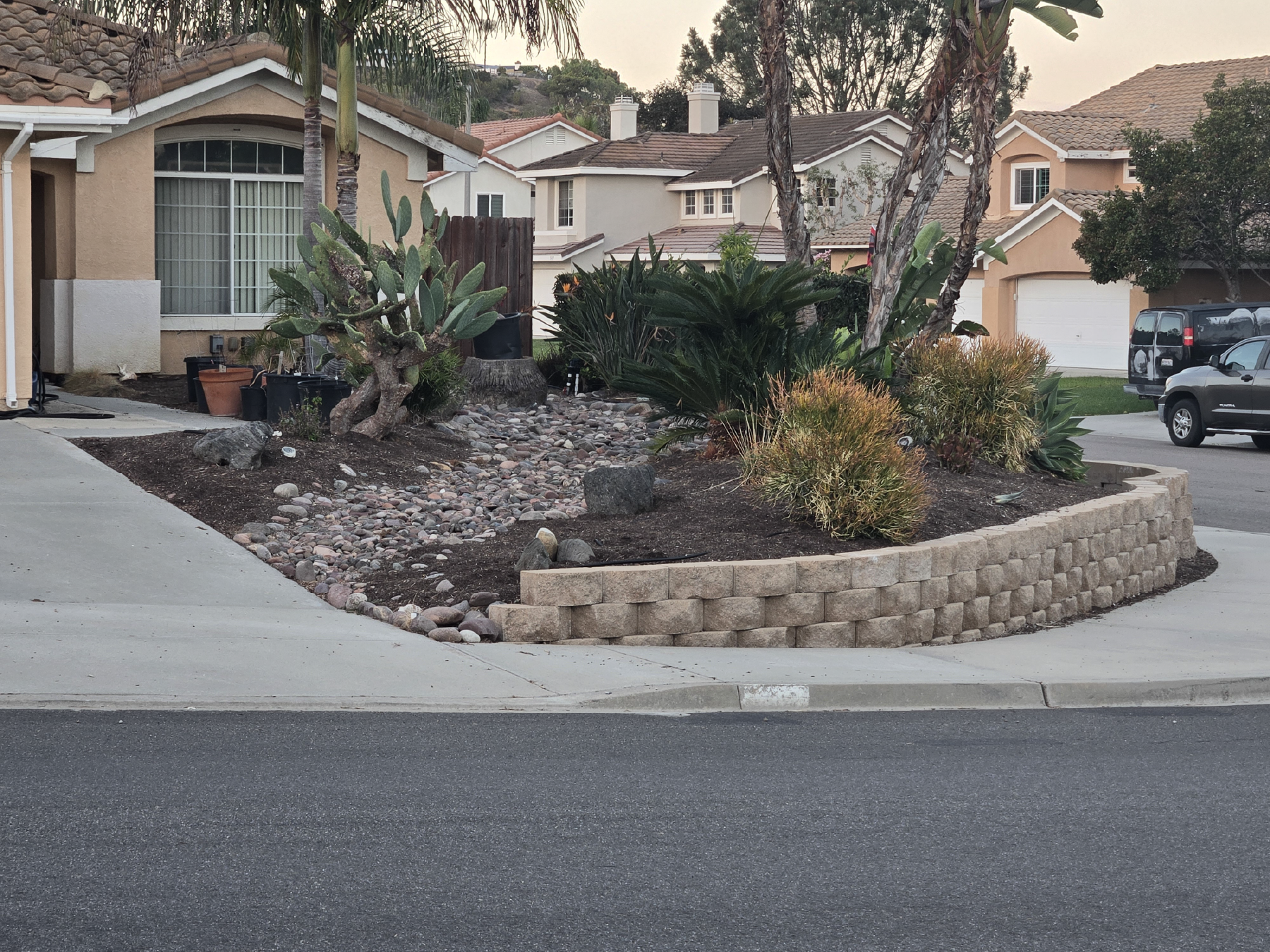
A retaining wall to reduce erosion. (Valorie Shatynski)
Terraces and retaining walls can be added in sloped areas to create a break in water flow and provide an attractive visual feature in landscapes and gardens. Some homeowners combine terraced low walls, raised garden beds and multilevel patios with walkways to make sloped yards more livable and increase planting areas. Stone, brick, interlocking blocks or retaining walls are a few of the ways to use terracing and reduce erosion and increase slope stability.
Swales slow water and allow it to percolate into the landscape. A swale can be is a shady spot, or a sunken or marshy place. It is a shallow channel with gently sloping sides, and can include infiltration basins designed to manage water runoff, filter pollutants, and increase rainwater infiltration. Bioswales have plants or vegetation in their construction (Wikipedia). These low spots and channeling features allow water to percolate into the soil instead of running off into the storm drain. To create swales or basins, begin at the highest point or where an area stays soggy. Dig it out to create a depression where water can percolate rather than run off.
Dry creek beds provide the same water slowing and percolation advantages as swales. Mainly, the appearance is different as a dry creek bed is a shallow, stone-lined trench or slightly lower area that catches water from gutter downspouts or landscape. This diversion can guide water runoff away from foundations and other structures. The feature allows runoff to percolate into the soil.
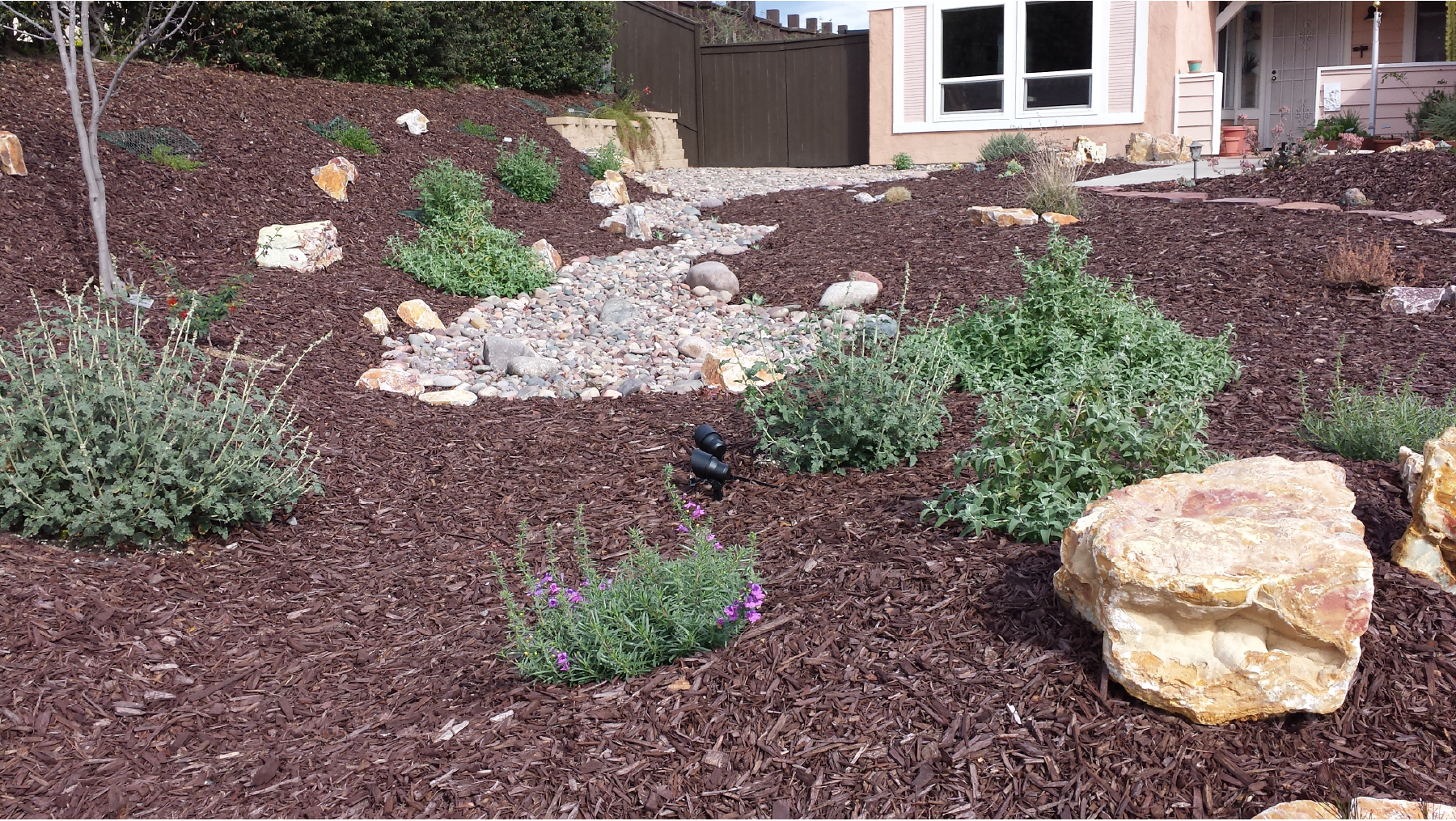
A dry creek bed and catch basin. (Valorie Shatynski)
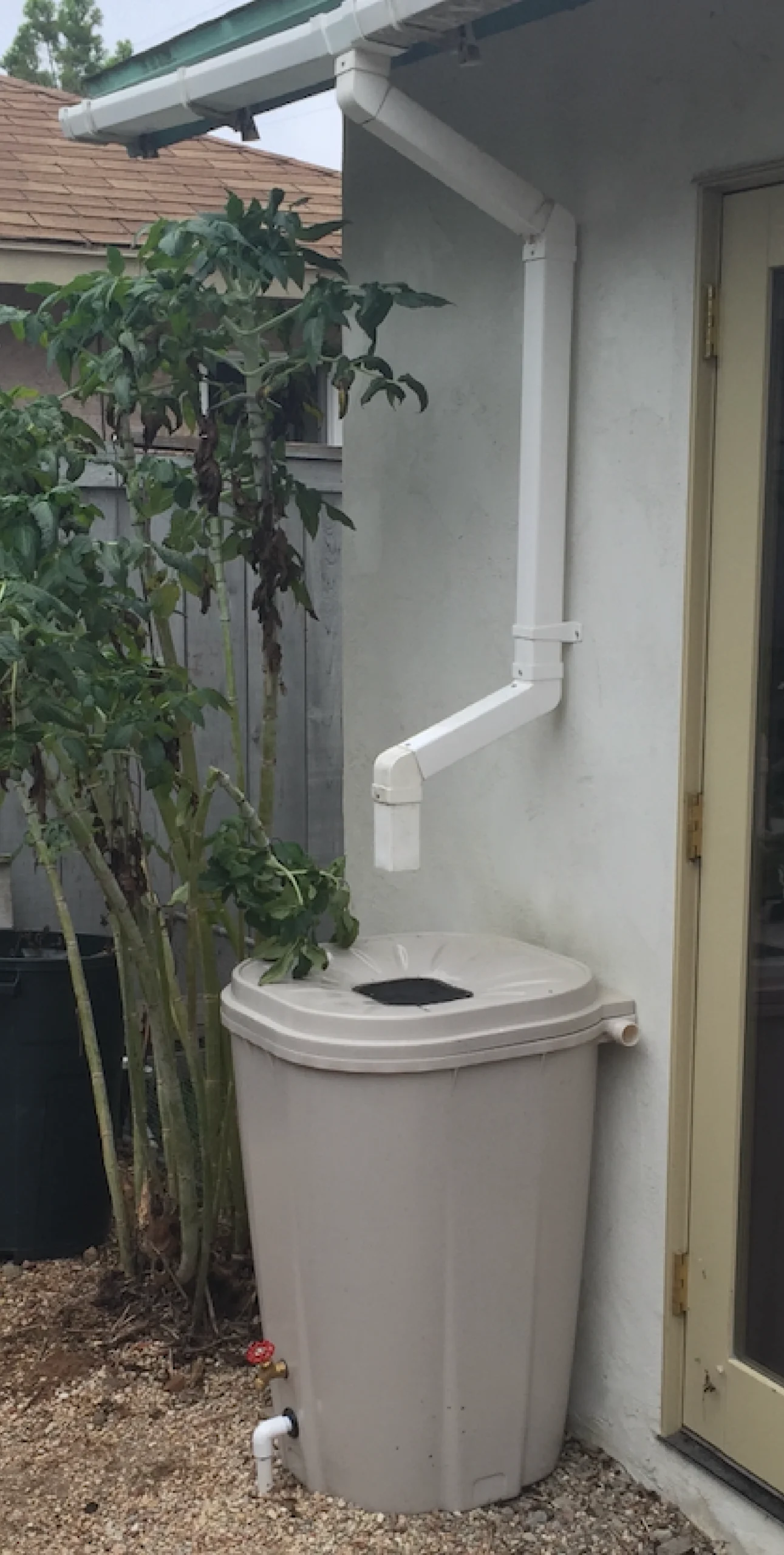
Rain Barrel (Joe Boldt)
Rain barrels are a good way to capture water before it hits hard surfaces, and also provide a watering source in dryer periods. Areas of gutters that cannot be directly drained into swales or dry creek beds can be managed with rain barrels which can capture water and store it for future use!
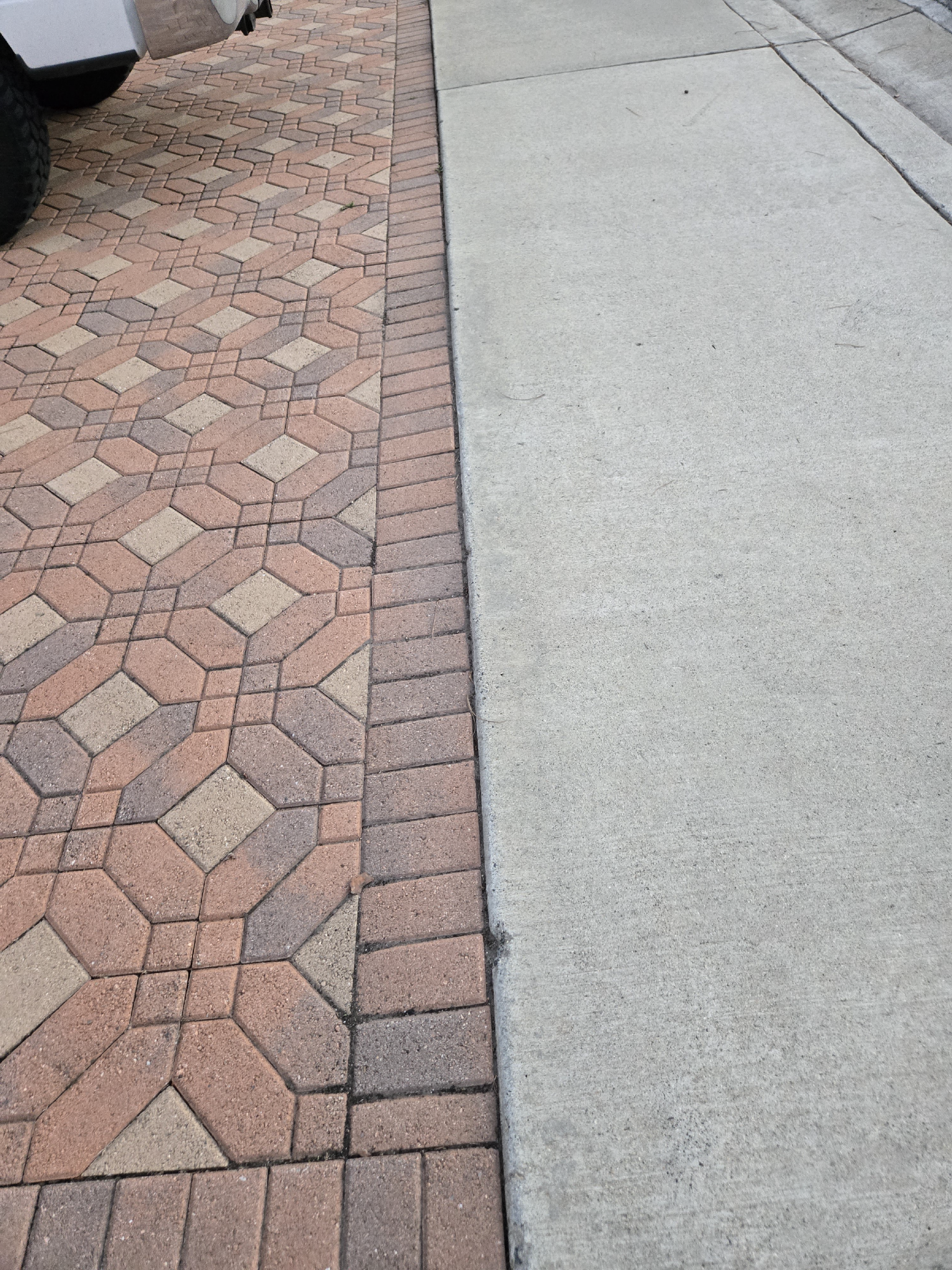
Permeable pavers (Valorie Shatynski)
Permeable surfaces can replace hard surfaces. Concrete walkways, driveways and other hard surface areas like patios can be converted to permeable surfaces. Material such as decomposed granite, small rock, and interlocking pavers are designed to allow water to soak in rather than run off. This is another one of those features that adds aesthetic appeal when replacing areas of the landscape that were previously concrete. Consider reducing or replacing lawn areas with permeable surfaces or garden beds. This is because the soil underneath lawns is usually compacted and does not absorb well when rainfall is heavy, creating more runoff offsite.
Mulches. Mulch is important in landscapes for retaining moisture and suppressing weeds. Mulches can be beneficial for erosion control on slopes, but the mulches must be large bark and larger rock mulch. Steep slopes that receive prolonged rains generally will not retain most mulches. Also, different plants prefer different types of mulch. For example, small to medium sized mulches are acceptable for shrubbery and trees dry landscapes, but Avocado trees prefer their own leaf litter. Landscapes with cacti, agave, succulents and most native plants prefer rock mulch or large bark mulch. Mulch from eucalyptus and some other types of plants are problematic and should be avoided.
Temporary Measures include sandbags stacked in high water flow spots to deflect water away from structures. On slopes, another temporary approach could be staked down straw wattles. The wattles help slow water runoff and erosion. This can be used among newly planted deep-rooted plants (native plants are ideal), that are not fully grown spread to cover the open ground. Straw floats and will not stay in place on steep slopes, as well as most mulches.
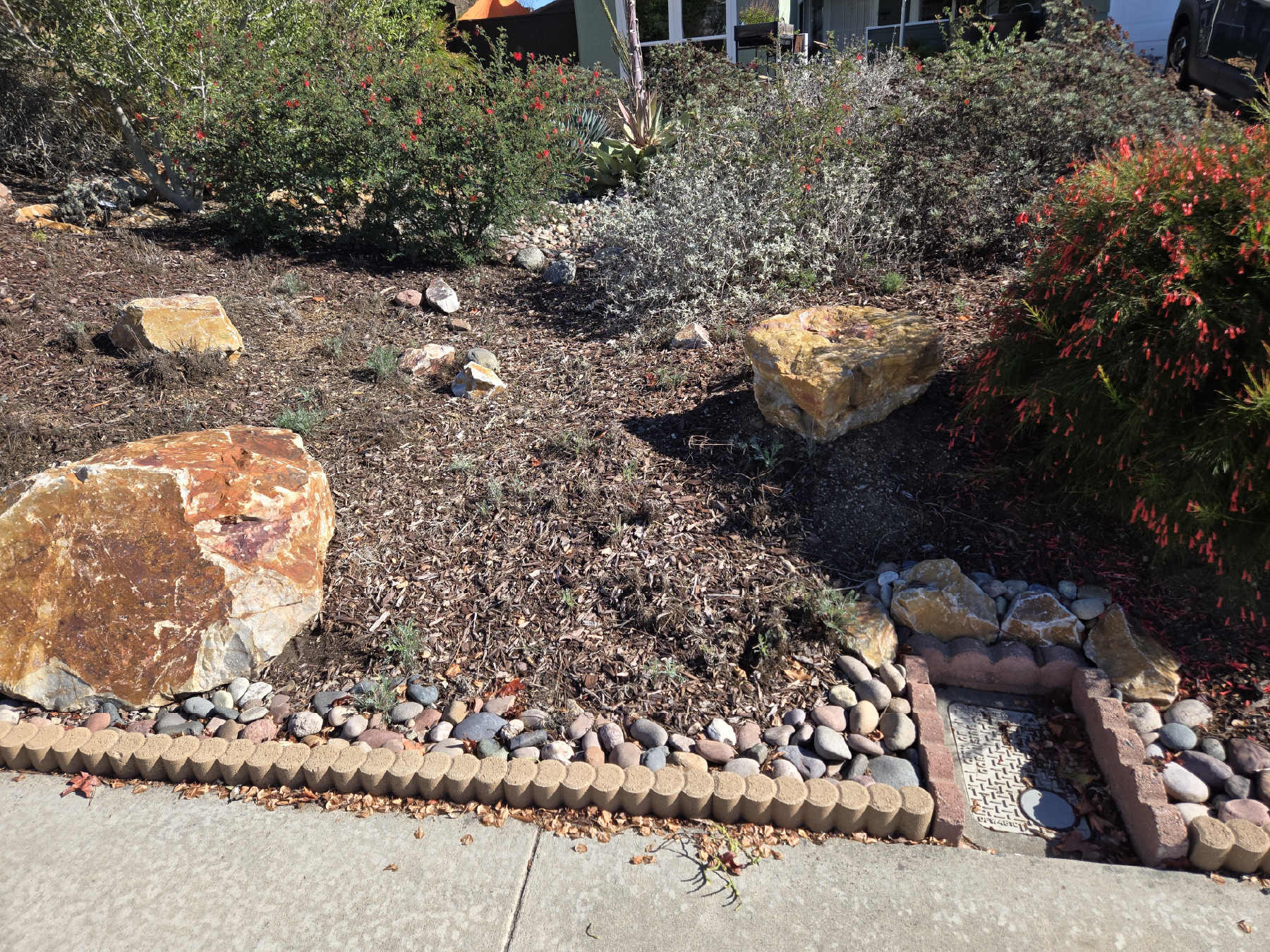
Edging to retain bark mulch (Valorie Shatynski)
Tree trimming – trim branches overhanging structures and remove branches that are weak and may have the potential to break during stormy windy periods.
Final thoughts on preparation. As mentioned previously, this season’s dire predictions regarding storm impacts from El Nino is not only motivation to protect our structures and landscapes, but also provides some opportunities. The opportunities lie in the solutions! Adding swales, terraces, creek beds, rocky areas and more reveal the appeal of the aesthetic improvements, while providing erosion control and preventing runoff from our landscapes!
Reference for landscaping:
This article shows more detail and photographs of slope erosion and failure: https://sandiego.surfrider.org/news/why-iceplant-is-not-good-for-slopes.
This article addresses landscape design and water quality, and also succinctly provides solutions for hard rain and erosion impacts: https://ipm.ucanr.edu/home-and-landscape/landscape-design-water-quality/#gsc.tab=0
Lowes how-to dry creek beds: https://www.lowes.com/n/how-to/build-a-dry-creek-bed
Las Pilitas native planting guide: https://www.laspilitas.com/classes/native_planting_guide.html
Bert Wilson with Las Pilitas Nursery has provided an excellent resource, “Simple erosion control for a hillside or garden slope:” https://www.laspilitas.com/garden/howto/slope.html. He explains how to identify potential drainage and erosion issues and simple solutions. He covers steep rock/clay slopes, sandy slopes, and more gradual garden slopes. It includes videos and also plant recommendations. He also debunks many myths regarding slope protection, based on research. Copyright © 1992-2026 Las Pilitas Nursery, Edited on Sep 18, 2013. Author: Bert Wilson
Native plants and fire prevention: https://www.laspilitas.com/fire.htm
CalScape Native plant search: https://calscape.org/search/ Scroll down the left side menu, select “Special Uses” and select from the drop-down menu.
CalScape Garden Planner: https://calscape.org/garden-planner/
Moosa Creek Nursery: https://www.moosacreeknursery.com/ Native plant retail online and have the plants delivered to a nursery around the county. The site has a catalog of what is available with descriptions, color photos and includes soil types, watering, flowering, dimensions, and wildlife that benefit from each plant.
San Diego County Water Authority: https://www.sdcwa.org/your-water/water-use-efficiency/. This site offers the “Nifty 50” low water use plants list and also a list called the “Happy 100.” Search for plants that are deeply-rooted.
CalPoly Select a Tree: This site allows searches by characteristics. A note, when planting near structures it is suggested to avoid trees with invasive root systems.
Resources for understanding weather, alerts, current conditions, safety
Weather and climate scientist, Daniel Swain with University of California Agriculture and Natural Resources (UCANR). Daniel hosts a popular blog, Weather West weatherwest.com. His post on October 12, 2026 provides an explanation, with great graphics.
Alert San Diego: https://www.alertsandiego.org/en-us/preparedness/flooding/elnino.html
Watch Duty: https://www.watchduty.org/how-it-works/overview Free app. Volunteers and first responders compile real time data regarding flood and fire events
Weather and Emergency Sites: https://www.sdcfcd.org/content/sdc/sdcfcd/weather.html
Valorie Shatynski has been a Master Gardener since 2016